

Gluten Free
What does following a gluten-free diet mean? That you're embarking on an easy diet with a wide range of health-promoting effects. Instead of dwelling on what you’re giving up, consider that you’re going to enjoy a whole new world of delicious food options to meet your special dietary needs. You’ll be eating seasonally, choosing more fresh fruits and vegetables, focusing on meats, seafood, poultry, legumes, lentils, corn, and rice, and discovering fascinating ancient grains such as quinoa, amaranth, and millet. You’ll be able to eat potatoes, eggs, most cheeses, even chocolate (!)—and enjoy them without guilt because you’ll be taking good care of your body. In fact, you’ll probably end up eating—and feeling—better than ever!
Visit this page for more information about living Gluten Free
---
We carry a large variety of gluten free items, the brands listed below represent just some of the offerings we carry














More Diets
- By Suzanne Dixon, MPH, MS, RD
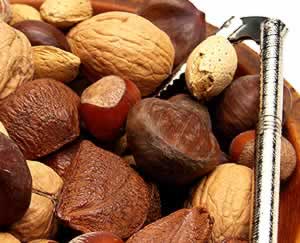
The Walnut Is One Brainy Nut
In a new twist on study aids, researchers have found hints that something as simple as eating walnuts may boost brainpower.
Try a handful of walnuts and dried fruit as a healthy snack
Testing a nutty diet
To test how eating walnuts affects brain function, researchers randomly selected 64 college students to follow their regular diet or their regular diet plus walnuts for 16 weeks. For 8 of the 16 weeks, half the group ate three slices of banana bread providing ½ cup walnuts per day, and the other half ate banana bread without walnuts.
All participants then ate their regular diet without walnuts for six weeks (called a washout period). The walnut and no-walnut groups were switched for the last eight weeks, so that everyone had an eight-week period of eating walnuts and an eight-week period of not eating walnuts.
Nonverbal reasoning, verbal reasoning, memory, and mood tests were conducted at the study’s initiation, after eight weeks of intervention, and again after the second eight weeks of walnut and no-walnut diets.
Inferential reasoning (the ability to draw accurate conclusions from a group of facts) was tested by reading the students a short narrative followed by five statements, after which they had to decide whether the statements were true, partially true, false, partially false, or whether there was not enough information to make a judgment.
Nuts make the difference
After analyzing the test results, the researchers noted an 11.2% increase in the ability to perform inferential reasoning among the students when they were on the walnut-supplemented diet compared with the no-walnut diet. They detected no significant increases in mood, non-verbal reasoning, or memory.
Go nuts
This study suggests that in young, healthy adults, walnuts may improve inferential reasoning. One study doesn’t prove walnuts are going to improve your brain function, but there aren’t many downsides to adding them into your healthy eating plan. Our tips and hints will help you get more walnuts into your diet.
- Try a handful of walnuts and dried fruit as a healthy snack. It takes no time to throw them into a baggie or small container and they are perfect to have on hand in your briefcase, gym bag, or purse.
- Don’t fret about the calories in walnuts. It’s true that nuts are caloric, but interestingly, studies suggest that people who eat nuts have an easier time maintaining a healthy body weight than non-nut eaters.
- Cook and bake with walnuts. They make a great addition to breads, muffins, cookies, and salads or roasted with vegetables in the oven.
(Br J Nutr 20011, doi: 10.1017/S0007114511004302)

Live Better We Can Help

Useful Links
Connect With Clark's
| Proud Member of | |||||
 |
 |
 |
|||
 |
 |
 |
|||
2026 © All Rights Reserved. Clark's Nutrition is a registered trademark of Clarks Nutritional Centers, Inc.
Terms of Use